What is Zone AE Flood Insurance?
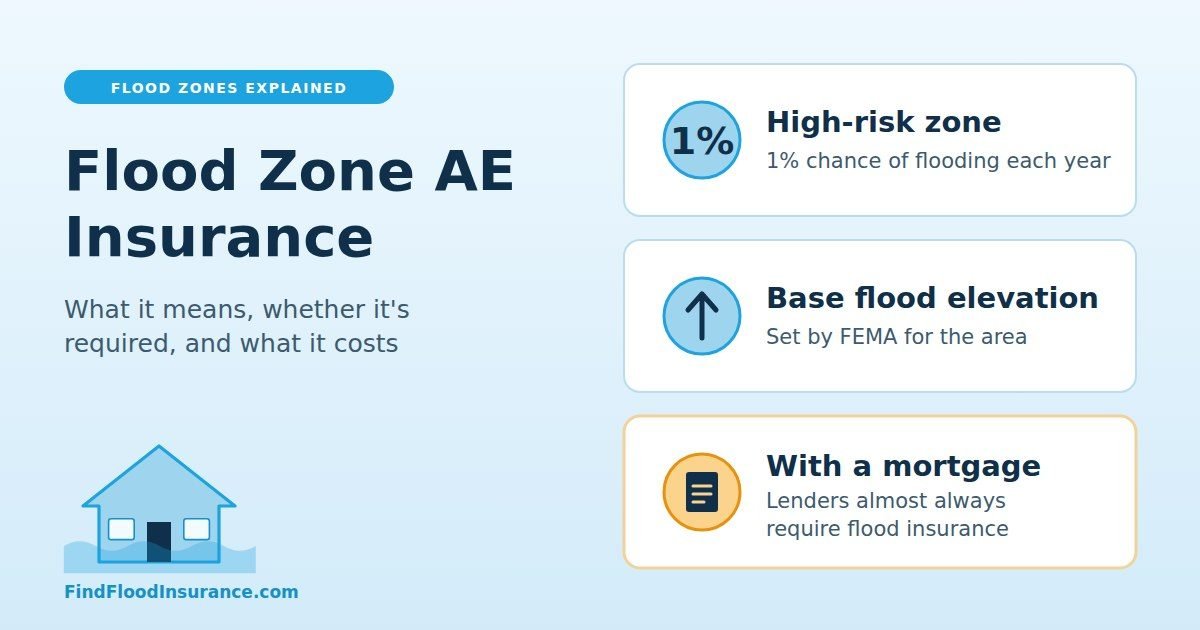
The short answer: zone AE flood insurance is a regular flood insurance policy for a home in flood zone AE, a high-risk area on FEMA flood maps. Zone AE covers land with a 1% chance of flooding in any given year, where FEMA has determined a base flood elevation. If you have a mortgage on a home in Zone AE, your lender will almost certainly require flood insurance, and it’s worth carrying without one. Your price depends on your property, not just the zone letter, so the only reliable number comes from a quote.
If you searched for zone AE flood insurance, you probably want to know what AE means, whether you have to buy coverage, and what it costs. This guide answers each of those, explains how AE differs from other zones, and covers what Michigan homeowners should know.
Last reviewed: October 2026. Flood maps, coverage limits, and program rules change, so confirm current figures with your agent.
What flood zone AE means
FEMA flood maps label every area by flood risk. Zone AE is one of the high-risk zones, which FEMA calls special flood hazard areas. The letters don’t spell anything out. An “A” zone is a high-risk area, and “AE” means FEMA has studied it and determined a base flood elevation, or BFE. FEMA’s flood zone definitions describe Zone AE as an area where base flood elevations are determined.
The base flood elevation is how high water is expected to rise in a flood that has a 1% chance of happening in any year. That’s why Zone AE is often called the 100-year floodplain. The label is misleading, because it doesn’t mean one flood every 100 years. FloodSmart says homes in high-risk areas have a 1 in 4 chance of flooding at least once over a 30-year mortgage.
Local building rules in the floodplain are tied to the BFE, and how high your home’s first floor sits above the ground is one of the things that sets your insurance price. Not sure which zone you’re in? Our Michigan flood zone map guide shows how to look up a property.
Does zone AE require flood insurance?
Usually, yes, if you have a mortgage. FloodSmart says that if you own a property in a high-risk zone and have a government-backed mortgage, you must buy flood insurance. Most lenders apply the same standard to their own loans, and the requirement lasts for the life of the loan. Lenders set their own standards for how much coverage they want and whether they accept a private policy, so confirm with yours before you buy or switch. If your coverage lapses, the lender can buy a policy for you, usually at a higher price. If you’re buying a home, our guide to flood insurance at closing in Michigan walks through the timing.
If you own your home outright, no federal rule requires you to carry flood insurance. But a home in Zone AE is in a high-risk area, a standard homeowners policy generally doesn’t cover flood, and the repair bill would be yours.
Condo buildings in a Zone AE area follow a different set of rules. Lenders usually look to the association’s master policy first, but that policy insures the building, not each owner. See flood insurance for condo associations.
How much does flood insurance cost in zone AE?
There’s no single price. Homes in a high-risk zone usually cost more to insure than homes in a low-risk zone, but NFIP pricing is now set property by property, so two homes in Zone AE can pay very different amounts. The main factors are:
- First floor height. How high the lowest floor sits above the ground.
- Foundation type. Slab, crawlspace, basement, or elevated on piers.
- Rebuild cost. What it would cost to rebuild, not your home’s market value.
- Construction and size. The building materials, square footage, and number of floors.
- Coverage and deductible. More coverage costs more, and a higher deductible lowers the premium.
- Discounts. Flood openings in the foundation and elevated machinery can earn credits.
Private carriers use their own risk models, so two companies can quote very different prices for the same house. For what drives price across Michigan, see our guide to the average cost of flood insurance in Michigan.
NFIP or private flood insurance in zone AE
Both are options. An NFIP policy offers up to $250,000 in building coverage and $100,000 in contents coverage for a single-family home. Private policies are written by insurance companies that set their own prices, limits, and terms, so coverage varies by carrier. Many private policies offer higher limits, and some start sooner than the NFIP’s typical 30-day waiting period. Most lenders accept private policies that meet their standards. The only way to know which is the better fit for your home is to compare quotes side by side. Our comparison of NFIP vs. private flood insurance covers the other differences.
Zone AE vs. other flood zones
Zone AE is one of several high-risk zones. Here’s how FEMA describes the common ones:
| Zone | Risk | What it means |
|---|---|---|
| AE | High | Base flood elevations determined |
| A | High | No base flood elevations determined |
| AH | High | Flood depths of 1 to 3 feet, usually ponding; base flood elevations determined |
| AO | High | Flood depths of 1 to 3 feet, usually water flowing across sloping ground; average depths determined instead of elevations |
| VE | High | Coastal flood zone with wave action; base flood elevations determined |
| X (shaded) | Moderate | Areas of 0.2% annual chance flood and some shallow-flooding areas |
| X (unshaded) | Minimal | Outside the 0.2% annual chance floodplain |
The difference between Zone A and Zone AE is the base flood elevation: A zones don’t have one determined, and AE zones do. Zone AO and Zone AH are shallow-flooding zones. In Zone AO, FEMA gives an average flood depth instead of an elevation, so the depth is what matters when you build or insure there. All of these are high-risk zones, and the lender rules above generally apply to each of them. Even outside them, FloodSmart notes that nearly one-third of NFIP claims from 2014 to 2024 came from outside high-risk areas.
Base flood elevation and elevation certificates
An elevation certificate is a form completed by a licensed land surveyor or registered professional engineer. It records your building’s lowest floor elevation and the ground next to it. According to FEMA’s guide for single-family homes, elevation certificates are no longer required for NFIP policies, but they’re an optional tool for establishing first floor height, and FEMA applies the value that’s most beneficial to the policyholder. If your home sits higher than FEMA’s estimate, a certificate can help. Ask your agent whether one is likely to lower your price before you pay for it.
Can you lower the cost or get out of zone AE?
You can’t change the map yourself, but you can work on the price:
- Compare NFIP and private quotes. This is the single biggest lever for most homeowners.
- Get an elevation certificate if it helps. See the section above.
- Ask about mitigation discounts. Proper flood openings in the foundation and elevated machinery, such as a furnace or water heater, can earn credits.
- Look at your deductible. A higher deductible lowers the premium. Pick one you could pay out of pocket after a flood.
- Ask about a Letter of Map Amendment. If your home sits on naturally high ground above the base flood elevation, you can ask FEMA for a Letter of Map Amendment (LOMA). If it’s approved, the federal requirement goes away, but your lender may still require coverage, and the flood risk doesn’t go away either.
Building or buying in zone AE in Michigan
Zone AE shows up where FEMA has mapped a river, lake, or shoreline floodplain, which includes areas along Michigan’s rivers and some of its lakeshores. Shoreline risk is changing too. See Great Lakes flood risk in Michigan.
Michigan also regulates building in floodplains. According to Michigan EGLE, a state permit is required before altering or occupying the 100-year floodplain of a river, stream, or drain with a drainage area of 2 square miles or more, and new residential construction is prohibited in the floodway. The state’s minimum standard for residential construction in the floodplain is a lowest floor one foot above the 100-year flood elevation, and some communities require more. Before you buy, build, or add on in a floodplain, check with your local building or floodplain office.
Steps to take
- Find your flood zone. Look up your address on FEMA’s map.
- Check whether your lender requires coverage. If you have a mortgage, ask what it requires.
- Gather your elevation information. Ask your agent whether an elevation certificate is worth getting.
- Compare NFIP and private quotes. Look at limits, how claims are paid, and the waiting period, not just the premium.
- Ask about discounts. Flood openings, elevated machinery, and your deductible can all change the price.
- Don’t wait for a storm. An NFIP policy typically has a 30-day waiting period.
- Get a quote.
Frequently asked questions
What does AE stand for in a flood zone?
The letters don’t spell anything out. “A” zones are high-risk flood areas, and “AE” means FEMA has determined a base flood elevation for the area.
Is flood zone AE high risk?
Yes. Zone AE is a high-risk zone, with a 1% chance of flooding in any given year. Over a 30-year mortgage, that adds up to about a 1 in 4 chance of at least one flood.
Does zone AE require flood insurance?
If you have a mortgage, your lender will almost certainly require it. Federal rules require flood insurance on a government-backed mortgage in a high-risk zone, and most other lenders do too. If you own your home outright, it isn’t required, but it’s still worth considering.
How much is flood insurance in zone AE?
It depends on your property. Pricing looks at things like your first floor height, foundation type, rebuild cost, coverage, and deductible, so two homes in Zone AE can pay very different amounts. A quote shows your real number.
Can you build in flood zone AE?
Often yes, but there are rules. In Michigan, building in the floodplain of a river, stream, or drain can require a state permit, new residential construction is prohibited in the floodway, and the lowest floor generally has to sit above the flood elevation. Check with your local building office first.
What is the difference between zone A and zone AE?
Both are high-risk zones. In Zone AE, FEMA has determined a base flood elevation. In Zone A, it hasn’t.
Get a zone AE flood insurance quote
We’re a Michigan agency that only sells flood insurance. Request a free flood insurance quote and we’ll compare NFIP and private options for your address so you can see the real numbers.
Want to keep learning? Browse the Michigan Flood Insurance Learning Center.