
Flood Insurance for Condo Associations: A Michigan Board’s Guide
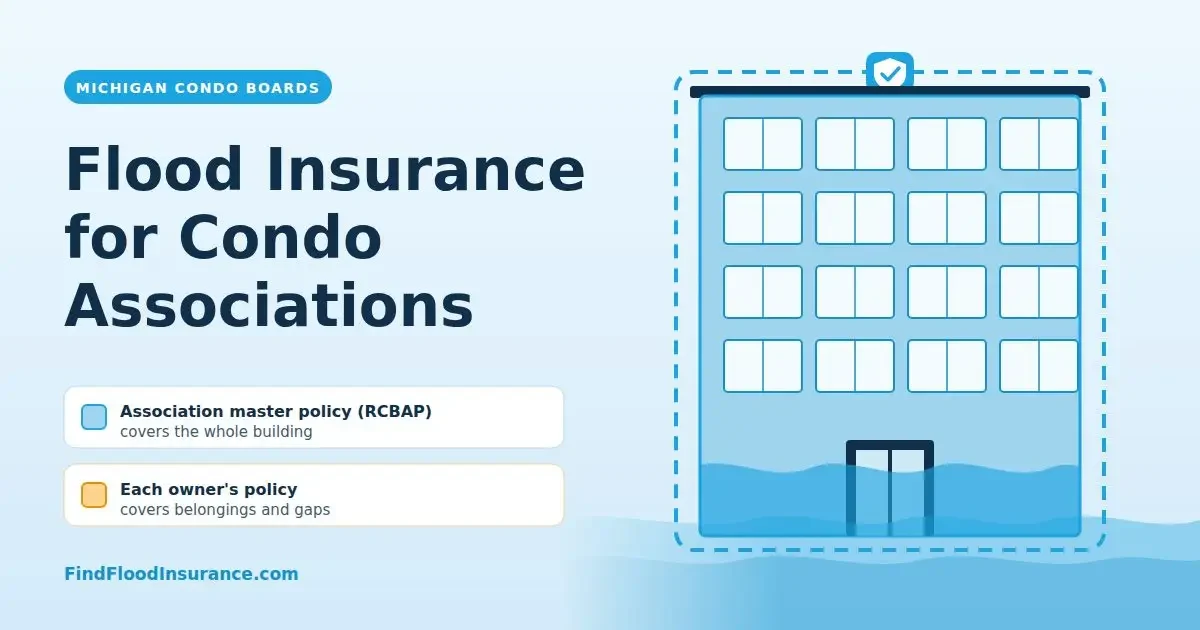
The short answer: most condo associations insure the building against flood with a Residential Condominium Building Association Policy (RCBAP) through the National Flood Insurance Program, or with a private policy built to work the same way. The association buys it and pays the premium from dues. The policy covers the building, including the units’ structure and fixtures, but not owners’ personal belongings. To avoid a penalty at claim time, the building generally has to be insured for at least 80% of its replacement cost, or the program maximum if that is lower.
If you sit on a Michigan condo board, flood insurance is one of the few coverages where a gap can turn into a bill for every owner in the building. This guide explains whether your association has to carry flood coverage, how an RCBAP works, the 80% rule that catches boards off guard, and what to ask your agent. If you own a unit, our guide on who pays for flood insurance in a condo covers the owner’s side.
Last reviewed: October 2026. Coverage limits and program rules change, so confirm current figures with your agent.
Does a condo association have to carry flood insurance?
Usually the pressure comes from lenders, not from a flood law aimed at associations. Most lenders require flood insurance on properties in a high-risk flood zone, and for a condo unit they typically look to the association’s master flood policy to meet that requirement. The premium is usually paid as a common expense. High-risk zones are the ones that begin with A or V, such as Zone AE. Each lender sets its own standards for the master policy, so ask yours what it requires.
Three things follow from that:
- If one owner’s loan needs it, the whole building feels it. A building without the required master policy can make units hard to finance or sell.
- Outside a mapped flood zone, the rules are looser, but the water is not. Our guide to flood insurance when you’re not in a flood zone explains why a low-risk label doesn’t mean no risk.
- Your own documents matter. The master deed and bylaws spell out what the association must insure and what falls to owners. Read them, and ask an attorney who knows Michigan condominium law if the language is unclear.
What an RCBAP covers, and what it doesn’t
The RCBAP is the NFIP policy written for condo buildings. According to FEMA’s guide for condominium associations and the RCBAP policy form:
| Covered | Not covered | |
|---|---|---|
| Building | The whole building at the insured address, including the units and the improvements within them. Foundation, structure, elevators and electrical systems, stairs, furnaces and water heaters, and built-in items such as cabinets and plumbing fixtures | Property outside the building, and the other exclusions listed in the policy |
| Contents | Optional coverage for property the owners hold in common or the association owns, such as lobby furniture, office equipment, and maintenance tools | Unit owners’ personal belongings |
| Limit | Up to $250,000 in building loss payments for any one unit | Losses above the limit |
| Assessments | Special assessments charged to owners (see below) |
Two practical points:
- The policy pays replacement cost, but only after repairs are done. Under the policy form, the association is not paid on a replacement cost basis until the repair or replacement is actually completed. Boards need cash or credit to bridge the gap.
- It starts late if you wait. An NFIP policy can carry a 30-day waiting period, so buying when a storm is in the forecast is too late.
Ask your agent for the declarations page. It shows the building limit, the deductible, and the replacement cost the policy is based on. If your board has never looked at it, start there.
The 80% rule that catches boards off guard
An RCBAP has a coinsurance requirement. Under the policy form, if the building is insured for less than 80% of its replacement cost, or the NFIP maximum if that is lower, a claim is paid at a reduced rate. The payment is the amount carried divided by the amount required, multiplied by the loss, less the deductible. Coverage on an owner’s separate policy can’t be added to the association’s policy to meet this test.
Here is an illustration with made-up numbers:
- Replacement cost of the building: $10,000,000
- Required at 80%: $8,000,000 (assuming the NFIP maximum for the building is higher)
- Coverage actually carried: $6,000,000
- Flood loss: $400,000
The policy would pay $6,000,000 ÷ $8,000,000 = 75% of the loss, or $300,000, before the deductible. The remaining $100,000 plus the deductible lands on the association, and from there on the owners.
This is why replacement cost needs a fresh look every few years. Construction costs rise, and a limit that was right when the policy was first bought may not be today. Many lenders look at a similar yardstick, but each sets its own, so ask yours what it expects.
Deductibles, special assessments, and reserves
The association’s deductible and any shortfall have to be paid by someone. Usually that means reserves first and a special assessment second.
- Your deductible is a budget decision. A higher deductible lowers the premium, but it raises the amount owners may have to pay after a flood. Lenders can limit how high it goes, so check their rules before you choose one.
- The RCBAP doesn’t cover assessments. Owners can buy loss assessment coverage on their own flood policy, which can pay their share of an assessment for flood damage, but, as FEMA explains, not an assessment caused by the association’s own deductible. Our owner’s guide walks through that.
- Owners should buy their own coverage. FEMA tells associations to encourage unit owners to carry their own contents or building coverage. A short note with the annual dues statement does that cheaply.
What drives the premium
An RCBAP premium depends on the building’s flood zone and elevation, the number of units, the replacement cost, the coverage amount, and the deductible. Because it’s a common expense, it shows up in every owner’s dues. A building in a higher-risk area costs more to insure, and that cost is shared.
Association boards often ask whether a private policy is cheaper or broader. Sometimes it is, and some lenders accept it. We compare the two in NFIP vs. private flood insurance in Michigan. For background on pricing trends, see why Michigan flood insurance costs went up. The fastest way to get a real number for your building is a free quote.
Why Michigan associations should pay attention
Michigan condos sit along the Great Lakes shoreline, beside rivers, and in dense areas where heavy rain overwhelms the drains. The state’s Department of Environment, Great Lakes, and Energy publishes Great Lakes coastal flood hazard studies showing how shoreline risk is being mapped. To find your building’s current zone, see our Michigan flood zone map guide or the FEMA Flood Map Service Center.
Flood risk differs a lot from city to city. Our Michigan service areas pages cover the local flood risks in each region.
Six steps for a condo board
- Pull the current policy and read the declarations page. Note the limit, deductible, and expiration date.
- Get an updated replacement cost figure from an appraiser or your agent, so you know what 80% means for your building.
- Check your flood zone and your lenders’ requirements.
- Compare the deductible to your reserves. Ask what a typical loss would do to dues.
- Compare NFIP and private options for the master policy.
- Tell owners what the policy covers and doesn’t, and point them to our guide to homeowners insurance and flooding so no one assumes their personal policy fills the gap.
Frequently asked questions
Does the HOA cover flood insurance?
It depends on the association. Many carry a master flood policy for the building, often because lenders require it, but the HOA’s policy doesn’t cover owners’ belongings. Owners usually need their own policy for contents and extra coverage. See our guide on who pays for flood insurance in a condo.
What is an RCBAP?
It stands for Residential Condominium Building Association Policy, the NFIP flood policy written for condo buildings. It insures the building, including the units and fixtures inside them, up to $250,000 per unit, with optional contents coverage for property the owners share.
Does the master flood policy cover the inside of my unit?
The RCBAP covers the building, including improvements within units, such as built-in cabinets and plumbing fixtures. It doesn’t cover an owner’s furniture, electronics, or clothing. If the building is underinsured, the claim payment can be reduced, which is why owners sometimes add their own building coverage.
Can a condo association buy private flood insurance?
Often, yes. Many lenders accept a private policy that meets their standards, but some have their own requirements. Check with your lenders first. Our NFIP vs. private comparison covers the tradeoffs.
How do we file a claim on the building?
Document the damage, notify your agent promptly, and keep repair estimates and receipts. Our guide to filing a flood insurance claim in Michigan walks through the steps.
How long before an association’s flood policy starts?
Plan on a 30-day waiting period, with some exceptions, such as certain policies tied to a loan closing. Buy before the storm season, not during it.
Get a flood insurance quote for your condo association
We’re a Michigan agency that only sells flood insurance, so we spend our day on questions like these. Request a free flood insurance quote and we’ll review your building, your current policy, and the gaps.
Want to keep learning? Browse the rest of the Michigan Flood Insurance Learning Center.