How Much Is Flood Insurance in Michigan? Average Cost Guide
The short answer: most Michigan homeowners with a National Flood Insurance Program (NFIP) policy pay roughly $800 to $1,050 a year, depending on whether you count only the base premium or the full bill with fees and surcharges. That works out to roughly $65 to $90 a month. Private flood policies are often cheaper for homes in lower-risk areas, though not always. Your own price depends on your property, so the only reliable number comes from real quotes.
If you’ve been searching for what flood insurance costs in Michigan, you’ve probably seen averages that don’t agree with each other. This guide explains where those numbers come from, what actually sets the price of your policy, how NFIP and private pricing compare, and how to lower what you pay without leaving a gap in your coverage.
Last reviewed: October 2026. Premiums and program rules change, so confirm current figures with your agent.
What flood insurance costs in Michigan on average
An analysis of FEMA’s NFIP policy data from August 2026 puts the average Michigan policy at about $807 a year, compared with about $955 for the country as a whole. That figure is the risk-based premium only. It leaves out the federal policy fee, the HFIAA surcharge, and the reserve fund assessment that get added to NFIP policies, which is why a typical bill, and many quotes, come out higher, often a little over $1,000 a year.
Three cautions about any average:
- It mixes very different homes. A house on a Great Lakes shoreline and a house on high ground in the same county can land far apart.
- Averages describe existing policies, not your quote. A new policy on your address could be higher or lower, depending on the factors below.
- Sources define “average” differently. Some include fees, some don’t, and some use quotes instead of policies. Treat any single number as a ballpark.
What sets the price of your policy
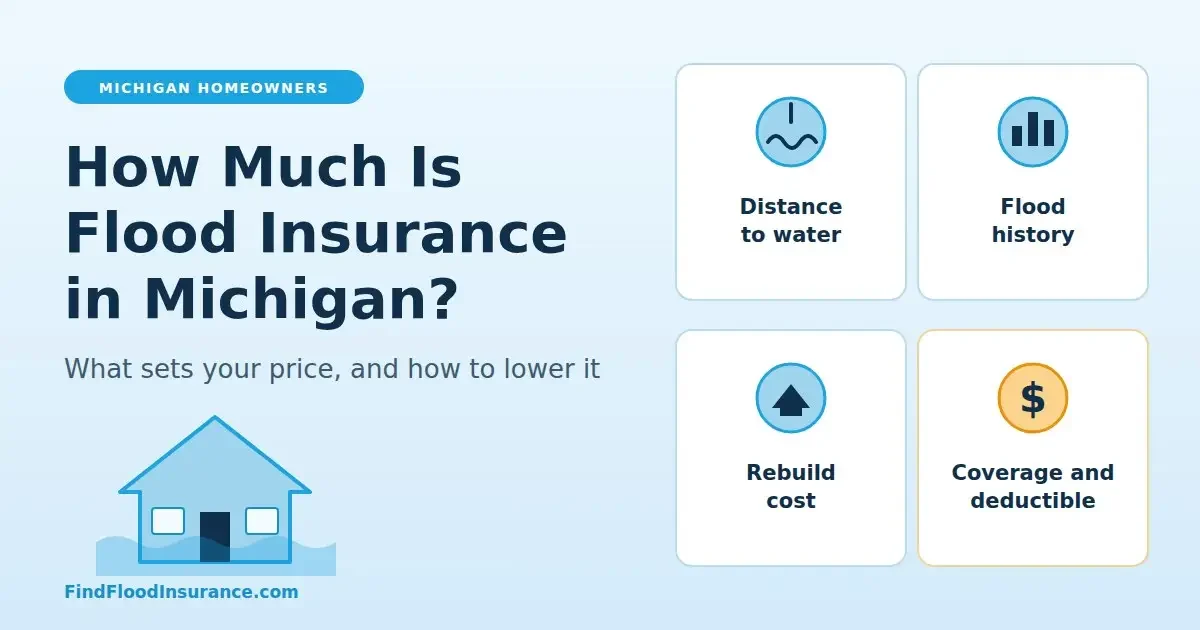
NFIP pricing is now based on the individual property, not mainly on the flood zone letter on the map. The main factors are:
- How close you are to water. Distance to a river, lake, or other flooding source.
- How often and how your area floods. Rising rivers, Great Lakes high water, and heavy rain overwhelming drains are priced differently.
- Your home’s characteristics. Foundation type, how high the first floor sits, and the number of floors.
- Rebuild cost. The cost to rebuild your home, not its market value. Our guide to flood insurance replacement cost explains why it matters.
- Your coverage and deductible. More coverage costs more, and a higher deductible lowers the premium.
- Discounts. Flood-resistant features can earn credits, and some communities qualify policyholders for a discount through the NFIP’s Community Rating System.
Private carriers use their own risk models and weigh these factors differently, which is why two companies can quote very different prices for the same house.
NFIP vs. private: how the price compares
Private flood insurance is priced by each carrier rather than set by the federal program. In general:
- Lower-risk homes often cost less with a private policy. For homes outside high-risk zones, private quotes frequently come in below the NFIP.
- Higher-risk homes can go either way. For a home in a high-risk zone, or one with prior flood claims, the NFIP is sometimes the cheaper option.
- Price isn’t the only difference. Coverage limits, how a claim is paid, and waiting periods vary too, so compare coverage as well as premium.
The only way to know which is cheaper for your address is to see both quotes side by side. Our guide to NFIP vs. private flood insurance covers the other differences.
Does your flood zone change the cost?
It can, but less than it used to. A home in a high-risk zone like Zone AE is usually more expensive to insure than a home in a low-risk zone, but under current NFIP pricing two homes in the same zone can pay very different amounts. Elevation, distance to water, and rebuild cost often matter more than the zone letter. If you’re in Zone AE and want the details, see our Zone AE flood insurance guide.
Why premiums have been rising
NFIP premiums have been moving toward full risk-based rates for years. According to a Congressional Research Service report, federal law limits annual increases to 18% for most primary residences and 25% for other properties until they reach their full risk-based rate, which means many homeowners see steady increases. That’s one reason it’s worth comparing options at every renewal, and we cover what changed in our post on why Michigan flood insurance costs went up.
How to lower what you pay
- Compare NFIP and private quotes. This is the single biggest lever for most homeowners.
- Look at your deductible. A higher deductible lowers the premium. Pick one you could pay out of pocket after a flood.
- Ask about discounts. Ask whether your community participates in the Community Rating System, and whether flood-resistant features on your home earn a credit.
- Don’t cut coverage to save money. Carrying too little building coverage can reduce what a claim pays. A small premium saving isn’t worth a large gap after a flood.
- Get a quote. Prices change, and a quote only takes a few minutes.
Why Michigan homeowners should check
Flood risk in Michigan doesn’t follow the maps neatly. Lakeshore homes, river towns, and older city neighborhoods with aging drainage all flood in different ways, and many of those homes sit outside the mapped high-risk zones. Because premiums are priced home by home, the neighbor’s price tells you very little about yours.
Frequently asked questions
How much is flood insurance per month in Michigan?
A typical NFIP policy runs roughly $65 to $90 a month, based on average annual premiums of roughly $800 to $1,050. Your price could be well below or above that, depending on your home and coverage.
Is flood insurance cheaper if I’m not in a flood zone?
Often, yes. Homes outside high-risk zones tend to cost less to insure, and a private policy may be cheaper still. Even so, flood damage happens outside mapped zones, so a low price can be a good value.
Is private flood insurance cheaper than NFIP in Michigan?
Often for lower-risk homes, and sometimes for others, but not always. Compare real quotes for your address, and look at coverage differences as well as the premium.
How can I find cheap flood insurance in Michigan?
Compare NFIP and private quotes, review your deductible, and ask about discounts. Avoid lowering your coverage so far that a claim wouldn’t cover the damage.
Why did my flood insurance premium go up?
Premiums for many NFIP policies rise each year until they reach their full risk-based rate. Fees and surcharges can change too. Comparing quotes at renewal shows whether another option is cheaper.
How much flood insurance can I buy?
The NFIP offers up to $250,000 in building coverage and $100,000 in contents coverage for a single-family home. Private policies often offer higher limits.
Get a flood insurance quote for your home
We’re a Michigan agency that only sells flood insurance. Request a free flood insurance quote and we’ll compare NFIP and private options for your address so you can see the real numbers.
Want to keep learning? Browse the Michigan Flood Insurance Learning Center.