
Flood Insurance for Rental Property in Michigan
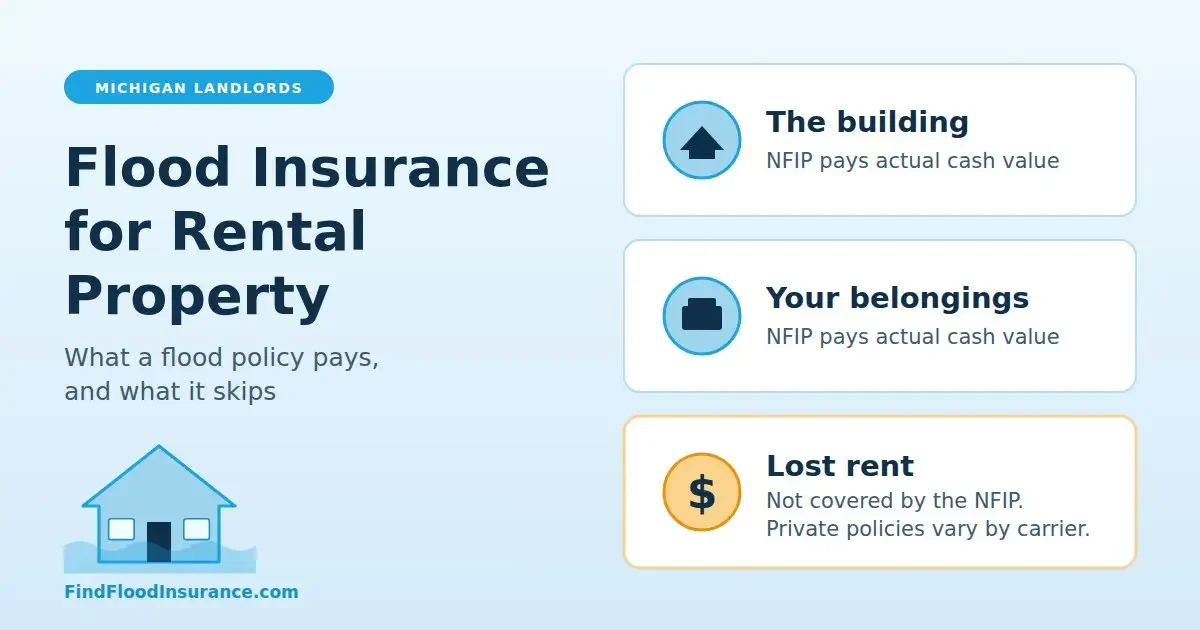
The short answer: flood insurance for rental property is a separate policy, because a standard landlord insurance policy generally doesn’t cover flood damage. A National Flood Insurance Program (NFIP) policy can insure a rental house or a building of up to four units, but it pays the building and your belongings at actual cash value (replacement cost minus depreciation), and it doesn’t pay lost rent. Some private flood policies offer higher limits and replacement cost, so compare both before you decide.
If you rent out a house, duplex, or small apartment building in Michigan, a flood can cost you twice: once to repair the building, and again in rent you can’t collect while the unit is empty. This guide explains what landlord insurance leaves out, what NFIP and private flood policies cover on a rental, why the NFIP doesn’t pay lost rent, and when a lender requires coverage. If you’re the tenant and want to protect your own belongings, see our guide to flood insurance for renters in Michigan.
Last reviewed: October 2026. Coverage limits and program rules change, so confirm current figures with your agent.
Does landlord insurance cover flood damage?
Usually not. Standard landlord policies, often called dwelling fire or rental dwelling policies, generally exclude flood. That means water that comes in from outside: a river that overflows, Great Lakes high water, runoff across the ground, or storm drains that can’t keep up. They typically do cover water from inside the building, like a burst pipe. Sewer and drain backup is often a separate endorsement, so ask your agent what yours says.
Your tenants’ renters policies generally exclude flood as well. That leaves flood coverage as a separate decision for you.
What NFIP flood insurance for rental property covers
The NFIP insures residential buildings with up to four units, which includes a single-family rental, a duplex, and a small multi-unit building. Buildings with five or more units are insured on a different NFIP form with different rules, so ask your agent about those. For one-to-four family buildings, FEMA’s guide for two-to-four family buildings lists maximums of $250,000 for the building and $100,000 for contents.
Here is how an NFIP policy generally treats a rental:
| What was damaged | How it’s generally paid |
|---|---|
| The building (single-family rental, duplex, or small multi-unit building) | Actual cash value, not replacement cost |
| Appliances, carpeting, and carpet padding | Actual cash value |
| Your personal belongings (contents coverage) | Actual cash value, always |
| Rent you lose while the unit is unlivable | Not covered |
| Your tenants’ belongings | Not covered by your policy |
If you supply furniture or equipment to tenants, ask your agent how it’s treated under the policy.
The first row matters most. A building that isn’t your principal residence is paid at actual cash value even if you carry plenty of coverage. On an older building, depreciation can shrink a payment considerably, and the gap comes out of your pocket. We explain the math in our guide to flood insurance replacement cost.
One more thing to ask about: if you rent out a finished basement or lower-level unit, find out how the policy treats that space. Coverage below the lowest elevated floor is limited under the NFIP.
What the NFIP doesn’t cover: lost rent
Lost rent is the biggest surprise for most landlords. FEMA’s summary of NFIP coverage lists financial losses from business interruption or loss of use of the insured property as not covered, along with additional living expenses such as temporary housing. In plain terms, if a flood makes a unit unlivable, the NFIP pays to repair the building (subject to its limits and the rules above), but it doesn’t replace the rent you lose while repairs are underway or pay to house your tenants somewhere else.
Repairs can take months, and your mortgage payment, property taxes, and utilities don’t stop while the unit sits empty, so plan for that gap separately.
What private flood insurance for landlords can add
Private flood insurance isn’t written on one standard form, so what you get depends on the carrier. For a landlord, these are the differences worth comparing:
- Higher limits. Some private policies offer building limits above the NFIP’s $250,000, which matters for larger or higher-value properties.
- Replacement cost. Some pay the building at replacement cost, even on a rental. Others use actual cash value, so read the loss settlement section.
- Shorter waiting periods. An NFIP policy typically has a 30-day waiting period, and many private policies start sooner.
- Rules for vacant or short-term rentals. Some policies restrict coverage when a property sits vacant or is rented by the night. Tell your agent how each property is used.
Private carriers can price a rental higher or lower than the NFIP, and terms vary, so compare coverage as well as premium. Our comparison of NFIP vs. private flood insurance covers the other differences, including lender acceptance.
Do landlords have to carry flood insurance?
No law requires every landlord to buy it. The requirement usually comes from your lender. If a property with a mortgage is in a high-risk flood zone, most lenders require flood insurance, and that includes rentals and investment properties, not only homes you live in. Lenders set their own standards for how much coverage they want and whether they accept a private policy, so confirm with yours before you buy or switch. If you’re buying a rental, the flood insurance conversation starts before closing, and our guide to flood insurance at closing in Michigan walks through it.
If you own a rental outright, or it sits in a lower-risk zone, nobody will make you buy flood insurance. But flood damage happens outside mapped high-risk zones too, and the repair bill would be yours.
What flood insurance for a rental property costs
NFIP pricing is based on the individual property: its distance to water, flood history, elevation, and rebuild cost. Our guide to the average cost of flood insurance in Michigan explains what moves the price. A rental adds two things on an NFIP policy:
- A higher surcharge. FEMA lists the HFIAA surcharge as $25 for primary residences and $250 for all other properties, so a rental pays $250 where a home you live in pays $25.
- Larger yearly increases. According to a Congressional Research Service report, federal law limits annual increases to 18% for most primary residences and 25% for other properties until they reach their full risk-based rate. A rental can see bigger yearly increases than a home you live in.
Private pricing is set by each carrier, so the only way to know which is cheaper for your property is to see both quotes side by side.
Why Michigan landlords should pay attention
Michigan’s rental stock includes older houses and small multi-unit buildings in river towns and city neighborhoods with aging drainage, along with lakeshore cottages and seasonal rentals on the Great Lakes. Flooding here comes from rising rivers, high Great Lakes water, and heavy rain overwhelming local drains, and it doesn’t stay inside the mapped high-risk zones. After a flood, tenants often move out, and a unit that stays empty for months can cost more than the repair bill alone suggests. That’s why how a policy pays the building is worth checking before the water arrives.
Steps to take
- Read your landlord policy. Look for the flood exclusion and for sewer and drain backup.
- Look up each property’s flood risk. Check its flood zone and ask about past flooding in the area.
- Decide what you need to protect. Estimate the cost to rebuild, your belongings, and how many months of rent you would lose if a unit sat empty.
- Compare NFIP and private quotes. Look at limits, how the building is paid, and the waiting period, not just the premium.
- Check with your lender. If there’s a mortgage, confirm what coverage it requires and whether a private policy is accepted.
- Tell your tenants. Your policy doesn’t cover their belongings, so suggest they ask about their own coverage.
- Get a quote early. An NFIP policy typically has a 30-day waiting period, so don’t wait for a storm.
Frequently asked questions
Does landlord insurance cover flood damage?
Generally no. Standard landlord policies exclude flood, so you need a separate flood policy. Landlord policies usually do cover water from inside the building, such as a burst pipe.
Does flood insurance cover lost rental income?
Not under the NFIP. It doesn’t pay for loss of use of the property or for temporary housing. Private policies vary by carrier, so ask what each one includes before you buy.
Can I get flood insurance on a rental property?
Yes. The NFIP insures residential buildings with up to four units, and private carriers write rentals too. Buildings with five or more units use a different NFIP form with different rules.
Do I need flood insurance on a rental property with a mortgage?
If the property is in a high-risk flood zone, most lenders require it. Each lender sets its own standards, so confirm the amount and whether it accepts a private policy before you buy.
Is flood insurance more expensive for a rental property?
It can be. NFIP policies on rentals carry a $250 surcharge instead of $25, and premiums can rise faster each year. Your price still depends on the property, so compare quotes.
Does it matter if my rental is a vacation or short-term rental?
It can. Some policies limit coverage for vacant or nightly rentals, and terms differ by carrier. Tell your agent how the property is used before you buy.
Get a flood insurance quote for your rental property
We’re a Michigan agency that only sells flood insurance. Request a free flood insurance quote and we’ll compare NFIP and private landlord flood insurance options for your property, including how each one pays the building and what the limits are.
Want to keep learning? Browse the Michigan Flood Insurance Learning Center.