
Flood Insurance Replacement Cost: What You Get Paid
The short answer: whether flood insurance pays replacement cost depends on the policy. Under the National Flood Insurance Program (NFIP), your home’s structure is paid at replacement cost, meaning the cost to repair or rebuild with no deduction for age or wear, only if it’s your main residence and your building coverage is at least 80% of its replacement cost, or the program maximum if that is lower. Otherwise it’s paid at actual cash value, which subtracts depreciation, and belongings are always paid at actual cash value. Private flood policies set their own terms, and many pay replacement cost on more of the claim, including belongings, so the policy wording matters.
Many Michigan homeowners assume a flood policy will pay to put everything back the way it was. Sometimes it will, and sometimes it won’t. This guide explains the difference between replacement cost and actual cash value, how NFIP and private policies each handle it, and how to check your own coverage before you need it. If you’re still sorting out whether flood damage is covered at all, start with our guide on whether homeowners insurance covers flooding.
Last reviewed: October 2026. Coverage limits and program rules change, so confirm current figures with your agent.
Replacement cost vs. actual cash value, in plain terms
FEMA’s NFIP summary of coverage defines the two terms this way, and private policies generally use them the same way:
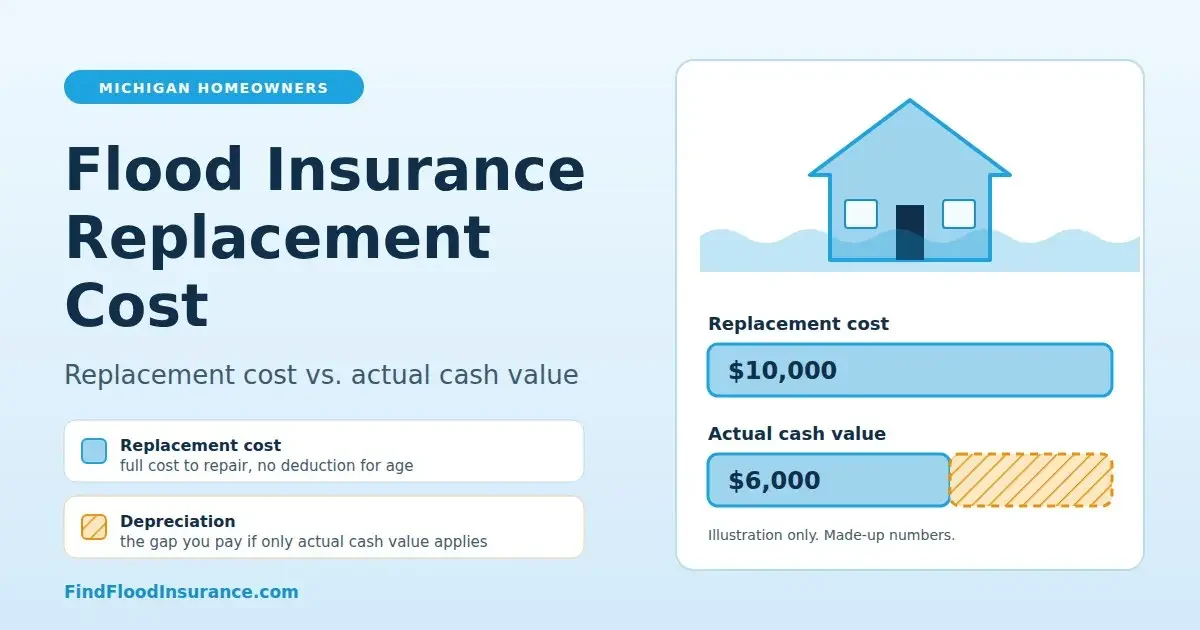
- Replacement cost value (RCV) is the cost to rebuild or repair using the same kind of materials and construction.
- Actual cash value (ACV) is the cost to replace the damaged property minus the value of its physical depreciation.
Here is an illustration with made-up numbers. Suppose flood water ruins drywall and flooring that would cost $10,000 to replace today. If those materials are ten years old and are treated as 40% depreciated, an ACV payment would be roughly $6,000, while a replacement cost payment would be the full $10,000 (before your deductible). Real depreciation depends on the item and its age, so treat these figures as a picture of the idea, not a prediction.
The gap matters most on a big loss. The older the materials, the larger the difference, and you cover the difference out of pocket.
How an NFIP policy pays replacement cost
Under the NFIP’s standard policy for homes (the Dwelling Form), replacement cost applies to the building when both of these are true:
- It’s a single-family home that is your principal residence. In other words, your main home, not a second home or a rental. The policy defines how long you must have lived there, so read that definition in your own policy.
- Your building coverage meets the 80% test. The amount of coverage on the home must be at least 80% of its full replacement cost just before the loss, or the maximum amount available under the NFIP if that is lower.
If either condition isn’t met, the building is paid at actual cash value. Here is how the FEMA Dwelling Form policy generally treats common situations:
| What was damaged | How it’s generally paid |
|---|---|
| Your main home, building coverage meets the 80% test | Replacement cost |
| Your main home, building coverage below the 80% test | Actual cash value |
| A second home or rental | Actual cash value |
| A building with two to four units | Actual cash value |
| Appliances, carpeting, and carpet padding | Actual cash value |
| Your personal belongings (contents coverage) | Actual cash value, always |
Even when replacement cost applies, the payment is capped at the smallest of three amounts: your building coverage limit, the replacement cost of the damaged part, or the amount you actually spend to repair or replace it. So keep your repair estimates and receipts.
Own a condo? The association’s master policy and your own policy split things differently. Our guide on who pays for flood insurance in a condo explains how.
The 80% rule, and the $250,000 ceiling
The 80% test compares your building coverage to what it would cost to rebuild your home, not to its market value or your loan balance. The land doesn’t need rebuilding, so it doesn’t count.
Here is an illustration with made-up numbers:
- Rebuild cost of $300,000: 80% is $240,000. A policy with $240,000 or more in building coverage meets the test. A policy with $200,000 does not, and the claim is paid at actual cash value.
- Rebuild cost of $400,000: 80% is $320,000, which is above the NFIP building maximum of $250,000. Carrying the maximum available meets the test, but the payment is still capped at $250,000. That leaves a $150,000 gap between what the NFIP can pay and what it would cost to rebuild.
That second example is where private coverage often comes in. A policy that satisfies your lender can still fall short of the 80% test, and an NFIP policy that meets the test can still fall short of your rebuild cost. Most lenders require only a minimum amount of coverage, and that minimum can be lower than what it would take to rebuild.
How private flood policies handle replacement cost
Private flood insurance isn’t written on one standard form. Each carrier sets its own loss settlement terms, so the answer to “does it pay replacement cost?” depends on the policy you buy. In general:
| NFIP | Private (varies by carrier) | |
|---|---|---|
| Building | Replacement cost if it’s your main home and meets the 80% test; otherwise actual cash value | Often replacement cost, but some policies use actual cash value or add their own conditions |
| Belongings | Actual cash value, always | Often available at replacement cost, sometimes as an option |
| Coverage limits | $250,000 building, $100,000 contents | Often much higher, and often customizable |
| Conditions | The principal residence and 80% requirements above | Set by the policy, and they differ from carrier to carrier |
Because there’s no standard form, read the loss settlement section of any private policy and ask three questions: Is the building paid at replacement cost or actual cash value? Is there a coinsurance or 80% requirement? Do I have to complete repairs before I’m paid the full amount? For a closer look at the other differences, including basements, waiting periods, and lender acceptance, see our comparison of NFIP and private flood insurance.
If you have a mortgage, confirm your lender accepts a private policy before you switch. Most lenders accept private policies that meet their standards, but each sets its own.
What replacement cost doesn’t change
Replacement cost changes how a covered loss is valued, not what is covered. Under an NFIP policy, coverage below the lowest elevated floor is limited to specific items, such as the furnace, water heater, and electrical panel, and finished basement walls, flooring, and belongings generally aren’t covered. Many private policies cover more in a basement, but it varies, so ask rather than assume. In either case, ask your agent how the policy treats the finished space in your home.
Why Michigan homeowners should check this
Michigan has plenty of older homes with plaster, hardwood, and finished basements, and those are the kinds of materials where depreciation takes a big bite out of an ACV payment. Rebuilding costs also tend to rise over the years, which means a building limit that was fine when you bought your policy may no longer meet the 80% test. For higher-value homes, including many near the Great Lakes, the NFIP’s $250,000 building limit may be well short of the rebuild cost even when the 80% test is met. Whether your flood risk comes from the lakes, a river, or heavy rain overwhelming local drainage, it’s worth confirming the numbers before the water arrives.
How to check your own coverage
- Pull your declarations page. It lists your building limit, contents limit, and deductibles.
- Get a replacement cost estimate for your home. Your homeowners policy often includes one, and your agent or a local contractor can help. Don’t use a real estate site’s price estimate, because market value and rebuild cost are different numbers.
- Compare the two. Multiply the rebuild cost by 0.8 and compare it to your building limit. If your home would cost more than $250,000 to rebuild, an NFIP policy alone leaves a gap.
- Read the loss settlement terms. For an NFIP policy, check the principal residence and 80% conditions. For a private policy, find how the building and belongings are valued.
- Compare an NFIP quote and a private quote side by side. Look at price, limits, and how each pays a claim, not just the premium. Remember that an NFIP policy can carry a 30-day waiting period, so don’t wait for a storm.
- Know what to do after a flood. Photos, receipts, and estimates all matter. Our guide on how to file a flood insurance claim walks through it.
Frequently asked questions
Does flood insurance pay replacement cost?
It depends on the policy. Under the NFIP, the structure of your main home is paid at replacement cost if your building coverage is at least 80% of its replacement cost, or the program maximum if that is lower. Otherwise it’s paid at actual cash value. Private policies set their own terms.
Does private flood insurance pay replacement cost?
Many private policies pay replacement cost on the building, belongings, or both, but it varies by carrier and policy. Some use actual cash value or add conditions, so read the loss settlement section before you buy. Renters can insure their belongings with a contents-only policy, which is covered in our guide to flood insurance for renters.
Does flood insurance pay replacement cost on my belongings?
Under an NFIP policy, no. Personal belongings are always paid at actual cash value, which subtracts depreciation. Many private policies offer replacement cost on belongings, sometimes as an option.
What if my house is a rental or second home?
Under the NFIP’s Dwelling Form, a home that isn’t your principal residence is generally paid at actual cash value, even if you carry plenty of coverage. Private policies set their own rules for second homes and rentals, so ask.
What is the most flood insurance will pay on my house?
For a single-family home, the NFIP offers up to $250,000 in building coverage and $100,000 in contents coverage. Private policies often offer higher limits.
Do I have to repair the house before I’m paid?
Under the NFIP, a replacement cost payment is limited to the amount you actually spend to repair or replace the damaged part, so keep estimates and receipts. Private policies differ, so ask how payments work on yours.
Is replacement cost the same as my home’s market value?
No. Market value includes the land and what buyers will pay. Replacement cost is the price to rebuild the structure.
Get a flood insurance quote that fits your rebuild cost
We’re a Michigan agency that only sells flood insurance. Request a free flood insurance quote and we’ll compare NFIP and private options side by side.
Want to keep learning? Browse the Michigan Flood Insurance Learning Center.